
To support the long‑term growth of airports and maintain the safety of aircraft and their passengers, the airspace surrounding an airport must be safeguarded from unsuitable development.
Australian Government regulations have therefore long recognised the importance of limiting the height of buildings and other structures, such as cranes located near airports or beneath flight paths. This controlled area of airspace is formally referred to as ‘prescribed airspace’.
These regulations are designed to ensure that:
- Aircraft can operate in airspace that is free from obstacles;
- Radar systems and other air navigation equipment function without interference; and
- Airport safety lighting remains visible and unobstructed.
Crane approvals
Objects in the vicinity of an airport have the potential to create air safety hazards and to seriously limit the scope of aviation operations into and out of the airport. The effects of individual obstacles may be relatively minor, but together a number of obstacles may seriously limit runway utilisation, cause airspace congestion and reduce the effective handling capacity of the airport.
While the most critical areas of concern are the immediate approach and take-off areas, it is equally true that objects up to and beyond 20 kilometres from the airport and apparently unrelated to the runway alignment can cause problems for pilots approaching or departing an airport.
Drone operations
CASA – Know your drone
Australians are flying drones in record numbers. More drones in the sky means it’s important we all understand the rules that keep us safe.
Important rules apply to drones around Hobart Airport. If your drone weighs more than 250 grams, you must fly at least 5.5 kilometres away from a controlled airport.
Rules for drone operators are set by the Civil Aviation Safety Authority. For more information watch the video below or visit the website.
What is Prescribed Airspace?
International standards have been adopted which define two sets of invisible surfaces above the ground around an airport. The airspace above these surfaces forms the airport’s prescribed airspace and is protected under the Act and Regulations. These two surfaces are the:
- Obstacle Limitation Surface (OLS) and
- Procedures for Air Navigational Services—Aircraft Operations (PANS-OPS) surface
The OLS is generally the lowest surface and is designed to provide protection for aircraft flying into or out of the airport when the pilot is flying by sight. The PANS-OPS surface is generally above the OLS and is designed to safeguard an aircraft from collision with obstacles when the aircraft’s flight may be guided solely by instruments, in conditions of poor visibility.
These charts depict airspace declared under the previous Regulations, the declarations of which continue in force following the commencement of the Airports (Protection of Airspace) Regulations 2026. These charts continue to depict the prescribed airspace connected with the airport however, some terminology shown on the charts may reflect the former Airports (Protection of Airspace) Regulations 1996. The change in terminology does not, and should not be taken to mean, that the airspace identified in the charts is no longer prescribed airspace. Any future update to prescribed airspace charts will reflect the modernised terminology within the 2026 Regulations.
What is a Controlled Activity?
Any activity that infringes the prescribed airspace is called a Controlled Activity and requires approval before they can be carried out. Controlled Activities include the following:
- constructing permanent structures, such as buildings, intruding into the protected airspace
- temporary structures such as cranes intruding into the protected airspace
- activities causing non-structural intrusions into the protected airspace such as air turbulence from stacks or vents, smoke, dust, steam or other gases or particulate matter.
- artificial light that may be capable of blinding or confusing points of aircraft operating in the prescribed airspace
The Regulations differentiate between short-term (less than 3 months) and long-term controlled activities. A short-term controlled activity may be approved by the airport operator, excluding PANS-OPS intrusions. A long term controlled activity requires approval by the Department of Infrastructure & Regional Development (DIRD). Any long term intrusions of the PANS-OPS surface are prohibited.
Carrying out a controlled activity without approval is an offence under Section 183 of the Airports Act 1996.
Approval process
All applications to carry out a controlled activity need to be submitted to Hobart Airport in writing.
The approval process varies depending on the type of controlled activity.
- Short-term controlled activities can be:
- approved or refused by the Airport after consultation with Local Council authority, CASA and Airservices, or;
- referred by the airport to the Department of Infrastructure and Regional Development for a decision.
- Long-term controlled activities penetrating the OLS are referred by the airport to the Department of Infrastructure and Regional Development for a decision after consultation with CASA, Airservices and the Local Council authority.
Long-term controlled activities penetrating the PANS-OPS airspace are not permitted.
Process
- Complete the online application form and submit to Hobart Airport
- Hobart Airport will review crane operation application
- Do the operations infringe on the protected airspace
-
- YES – Application is provided to Airservices and CASA for their assessment (allow 6 weeks)
- NO – Hobart Airport will issue an approval and submit a NOTAM. (Allow minimum of 3 working days)
Drawing
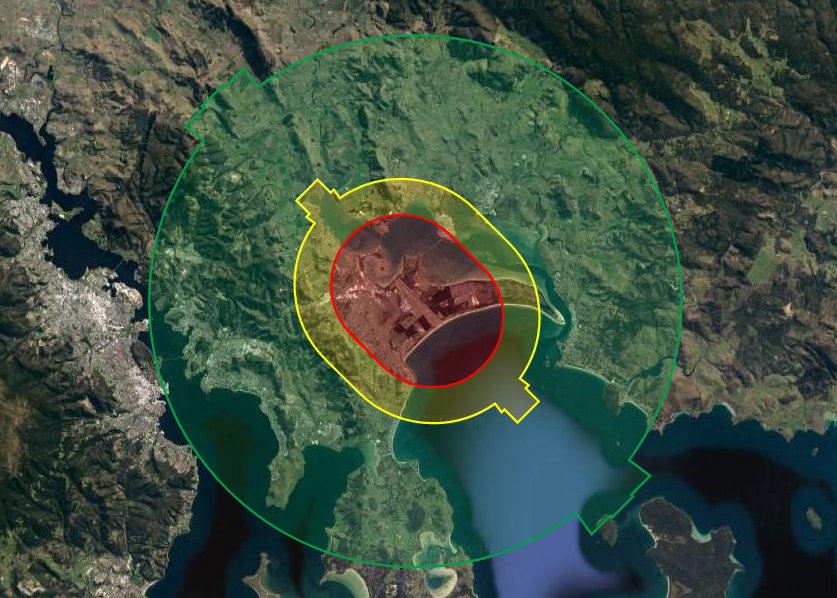
The below map will assist you in deciding if your crane operations are required to be notified to Hobart Airport
Red Zone – ALL – Hobart Airport must be notified of all crane operations
Yellow Zone – >45m AMSL– Hobart Airport must be notified of all crane operations where the cranes boom height + the ground level exceeds 45m.
Green Zone – >110m AMSL – Hobart Airport must be notified of all crane operations where the cranes boom height + the ground level exceeds 110m.
Crane form